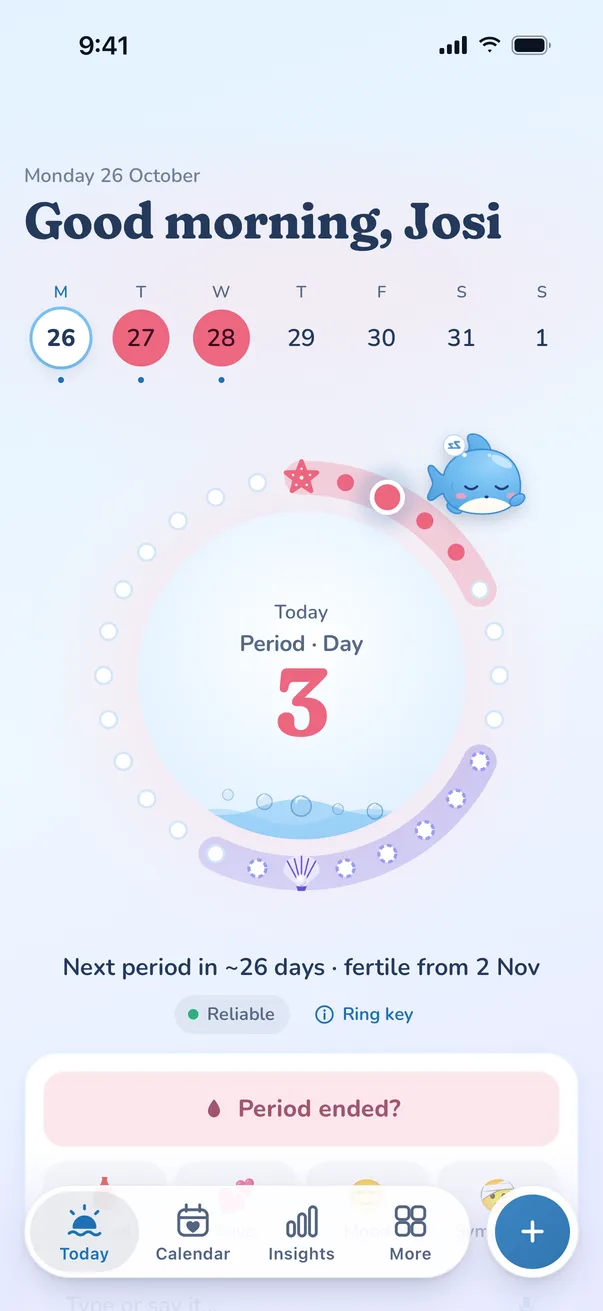
How does the cycle phase calculator work?
- Your cycle day counts from the first day of your last period (day 1).
- The menstrual phase is your period. The follicular phase runs from day 1 up to ovulation, so it overlaps the period.
- Ovulation is estimated at about 14 days before your next period. We call the day either side the ovulation phase.
- The luteal phase runs from after ovulation until your next period starts, usually 10 to 16 days.
The four phases, briefly
Phases are a way of describing hormone changes, not hard edges. How you feel in each varies a lot from person to person, so noticing your own pattern beats any rule. See the four phases explained.
When to see a doctor
- Your cycles are often shorter than 21 or longer than 35 days.
- Mood or physical symptoms in one phase are hard to live with: try our PMS or PMDD check.
- You bleed between periods or after sex.
In the UK you can call NHS 111 for advice, any time. In an emergency call 999 (UK) or 911 (US).
Questions people ask
What are the four phases of the menstrual cycle?
Menstrual (your period), follicular (from day 1 until ovulation, as a follicle matures and oestrogen rises), ovulation (an egg is released) and luteal (progesterone rises; if there's no pregnancy, it falls and your period starts).
Which phase is the longest?
It varies. The follicular phase changes the most from cycle to cycle, which is why longer cycles usually mean later ovulation. The luteal phase is more stable, often 12 to 14 days.
Should I change my workouts or diet by phase?
Some people find certain things feel better at different points. The evidence for strict "cycle syncing" is thin, so treat it as noticing what works for you, not a rule.
Does this work on the pill?
No. Combined hormonal contraception stops ovulation, so there are no natural phases. The bleed on a break is a withdrawal bleed.
Is anything I enter saved or sent?
No. Everything runs in your browser. Nothing is stored or sent, and the page makes no network requests when you use it.
Sources
- NHS: Periods
- Bull JR et al. Real-world menstrual cycle characteristics of more than 600,000 menstrual cycles. npj Digital Medicine, 2019
- Munro MG et al. FIGO systems for abnormal uterine bleeding (2018 revision). Int J Gynaecol Obstet
- Wilcox AJ et al. Timing of sexual intercourse in relation to ovulation. NEJM, 1995
Written by the Splash team · Sources checked Oct 2026 · Updated