How does the cycle length calculator work?
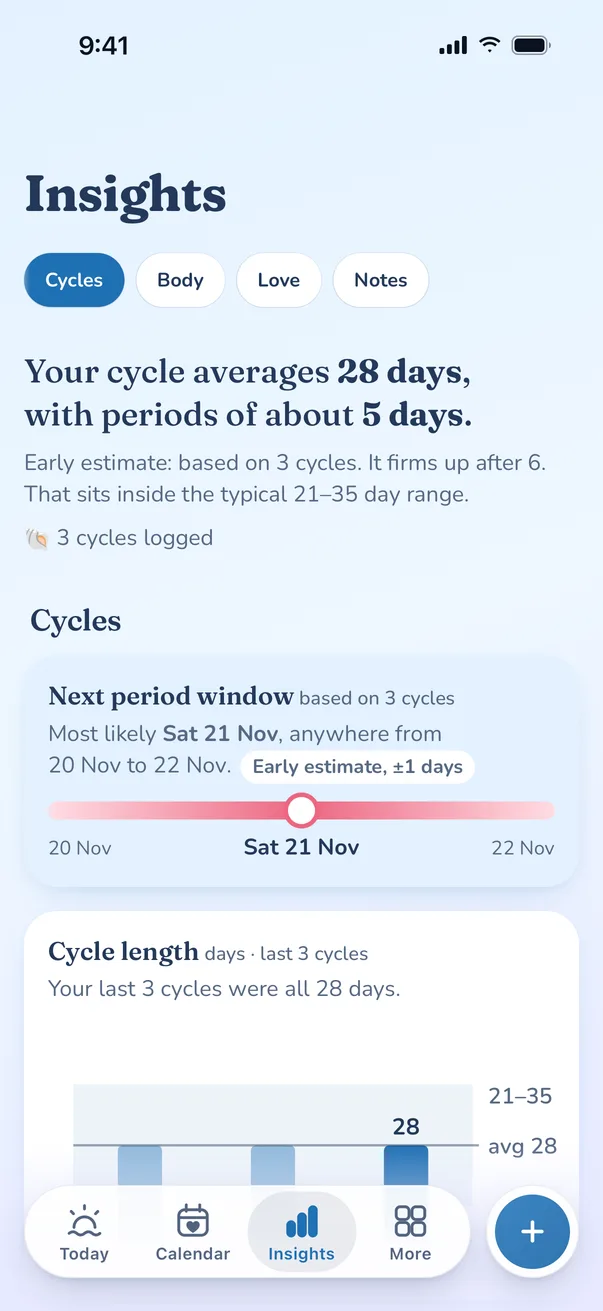
- Each cycle length is the number of days from one period start to the next.
- Average = all your cycle lengths added up and divided by how many there are. Variation = longest minus shortest.
- FIGO (2018) calls 24 to 38 days a normal frequency, and a variation of 7 days or less regular (up to 9 days is normal for ages 18 to 25 and 42 to 45).
- Gaps under 18 or over 50 days are flagged as a possible missed log and left out of the average, as the Splash app does.
What the guidelines call normal
The International Federation of Gynecology and Obstetrics (FIGO) describes a normal cycle for adults as 24 to 38 days, and a regular one as varying by no more than 7 to 9 days from shortest to longest. For teenagers, ACOG says cycles of 21 to 45 days are typical in the first few years.
"Irregular" isn't a diagnosis, and lots of things nudge a cycle, from stress to travel to breastfeeding. But a pattern is worth sharing with a GP if your cycles are often under 21 or over 35 days, swing by more than 20 days, or your periods stop for 3 months (NHS). Read more on irregular cycles.
Questions people ask
How do I calculate my cycle length?
Count from the first day of one period (day 1) up to the day before your next period starts. Doing that for a few months gives you your average.
What counts as an irregular cycle?
In adults, FIGO describes cycles as irregular when the shortest and longest differ by more than 7 to 9 days. Cycles under 24 or over 38 days are described as frequent or infrequent.
Is it normal for my cycle to change?
Yes, a little. A 2019 study of over 600,000 cycles found that cycle length tends to shorten slightly with age, and that variation of a few days is common.
When should I see a doctor about my cycle?
If your cycles are often shorter than 21 days or longer than 35, vary by more than 20 days, your periods stop for 3 months or more, or you're worried about any change, talk to a GP (NHS).
I'm a teen. What's normal for me?
In the first few years after periods start, cycles of 21 to 45 days are common (ACOG). They usually settle over time.
Are my dates saved?
No. Nothing leaves your browser. Close the tab and they're gone.
Sources
- Munro MG et al. FIGO systems for abnormal uterine bleeding (2018 revision). Int J Gynaecol Obstet
- ACOG Committee Opinion 651: Menstruation in girls and adolescents
- Bull JR et al. Real-world menstrual cycle characteristics of more than 600,000 menstrual cycles. npj Digital Medicine, 2019
- NHS: Irregular periods
- NHS: Periods
Written by the Splash team · Sources checked Oct 2026 · Updated