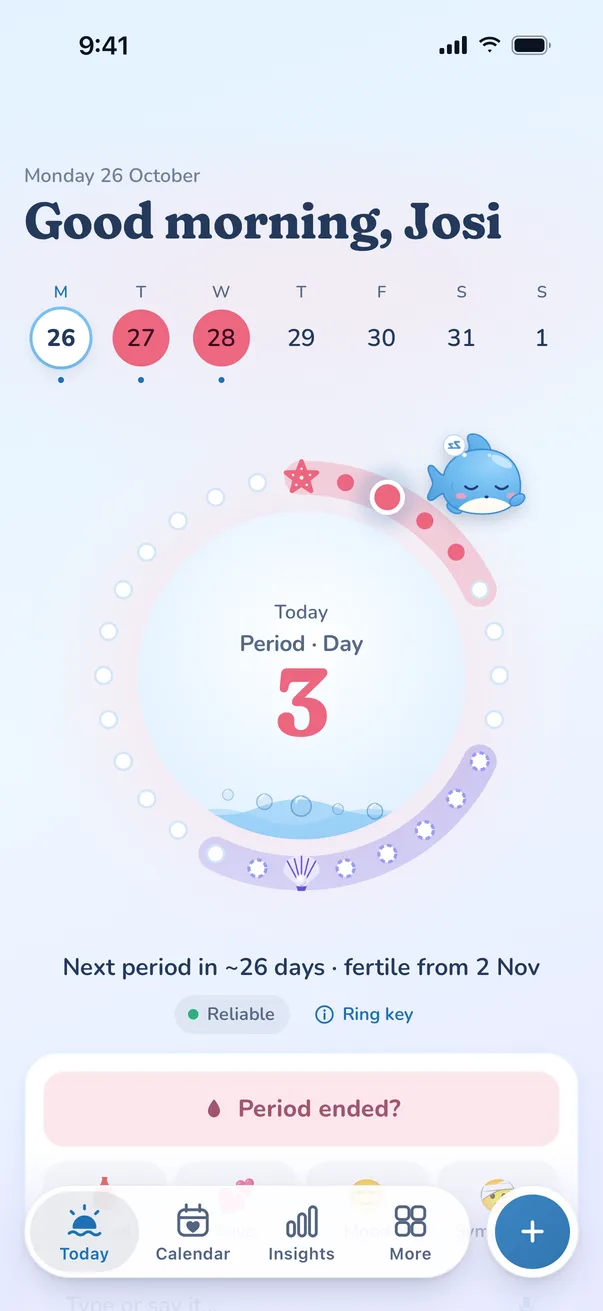
How does the ovulation calculator work?
- After ovulation, the luteal phase usually lasts about 14 days. So we count back 14 days from your next expected period to estimate ovulation.
- Sperm can survive up to 5 days and an egg lives about a day, so the fertile window is the 5 days before ovulation plus the day after.
- The best chances are the 2 days before ovulation and ovulation day itself (Wilcox, 1995).
- If you know your luteal phase from LH tests or temperature, you can change it under "More options".
The fertile window, in one picture
Pregnancy is only possible on about six days of each cycle: the five days before ovulation and ovulation day, with a small chance the day after. The best odds are in the two days before ovulation and on the day itself (Wilcox et al., 1995). In the ring above those days are blue hearts, and ovulation is the pearl.
Ovulation day by cycle length
Ovulation usually happens about 14 days before your next period, not 14 days after your last one. So the longer your cycle, the later you ovulate. These are typical estimates, assuming a 14-day luteal phase.
| Cycle length | Estimated ovulation | Fertile window |
|---|---|---|
| 21 days | Day 7 | Days 2 to 8 |
| 24 days | Day 10 | Days 5 to 11 |
| 26 days | Day 12 | Days 7 to 13 |
| 28 days | Day 14 | Days 9 to 15 |
| 30 days | Day 16 | Days 11 to 17 |
| 32 days | Day 18 | Days 13 to 19 |
| 35 days | Day 21 | Days 16 to 22 |
Day 1 is the first day of your period. If your cycles vary, look at both ends of your usual range: a cycle that runs 26 to 32 days could mean ovulation anywhere from about day 12 to day 18.
Signs your body gives around ovulation
A calculator only knows the calendar. Your body gives more direct clues, and tracking them tells you far more about your own cycle (NHS).
- A positive LH test. Luteinising hormone surges roughly 24 to 36 hours before ovulation. See how to use LH tests.
- Clear, stretchy cervical mucus. Mucus that looks like raw egg white tends to appear in the most fertile days.
- A rise in basal body temperature. Resting temperature goes up by about 0.2 to 0.5°C after ovulation and stays up until your period. It confirms ovulation afterwards rather than predicting it. Try the BBT chart reader.
- One-sided twinges. Some people feel a mild ache low on one side, called mittelschmerz.
Read more in signs of ovulation and timing sex when trying to conceive.
Why this can't be used to avoid pregnancy
Ovulation doesn't keep to the calendar. Even people with regular cycles ovulate on different days from month to month, and the fertile window can start surprisingly early (Wilcox et al., 2000). Sperm can survive up to five days. A calendar estimate like this one can't tell you which days are free of risk.
If you want to avoid pregnancy, use a method that is contraception. Our guide to contraception methods compares them, and fertility awareness, honestly explained covers what trained fertility-awareness methods involve.
Questions people ask
How accurate is an ovulation calculator?
It's a rough guide. In one study, the fertile window fell on different days for most people and even in regular cycles it was hard to predict (Wilcox, 2000). LH tests, cervical mucus and basal body temperature tell you more about your own cycle.
What is the fertile window?
The days in each cycle when sex can lead to pregnancy: about 5 days before ovulation, ovulation day, and roughly a day after.
What day do I ovulate on a 28-day cycle?
Around day 14, counting the first day of your period as day 1, with a fertile window of roughly days 9 to 15. On a 30-day cycle it is around day 16, and on a 35-day cycle around day 21. This assumes a 14-day luteal phase; your real day can be earlier or later.
Can I use this as birth control?
No. Splash is not contraception and this calculator must not be used to avoid pregnancy. Fertility awareness taught by a trained teacher, using several daily signs, is a different thing from a calendar estimate (NHS).
I have irregular cycles. Will this work?
It will be less reliable, because ovulation day moves when cycle length changes. Try our cycle length calculator to see your range, and consider LH tests. If your cycles are often shorter than 21 or longer than 35 days, it's worth mentioning to a GP.
When should I see someone if I'm trying to conceive?
The NHS suggests seeing a GP if you haven't conceived after a year of trying, or sooner if you're 36 or over or know of a fertility concern.
Does this page store my dates?
No. Everything is calculated on your device. Nothing is saved or sent.
Sources
- Wilcox AJ et al. Timing of sexual intercourse in relation to ovulation. NEJM, 1995
- Wilcox AJ et al. The timing of the "fertile window" in the menstrual cycle. BMJ, 2000
- NHS: Trying to get pregnant
- NHS: Natural family planning (fertility awareness)
- Bull JR et al. Real-world menstrual cycle characteristics of more than 600,000 menstrual cycles. npj Digital Medicine, 2019
Written by the Splash team · Sources checked Oct 2026 · Updated