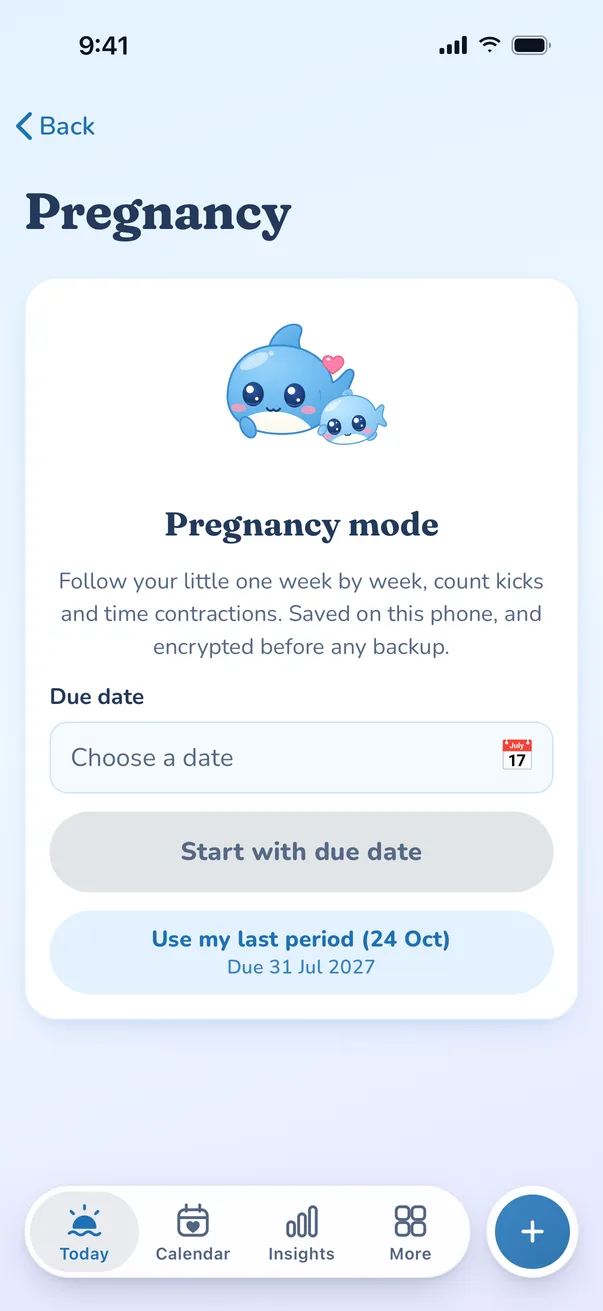
How does the how far along am i? work?
- Weeks of pregnancy count from the first day of your last period, not from conception.
- If your cycles aren't 28 days, we adjust by the difference. A due date works backwards: due date minus 280 days.
- "16+3" means 16 completed weeks and 3 days. Trimesters change at 14+0 and 28+0.
- The care timeline follows the NHS schedule. Your own appointments may differ.
Your care, week by week (UK)
Most people see a midwife for a booking appointment by 10 weeks, have a dating scan between 10 and 14 weeks and an anomaly scan between 18 and 21 weeks. The whooping cough vaccine is offered from 16 weeks. Your own schedule may differ, so follow your midwife's plan (NHS). For the bigger picture, see trimesters explained.
When to see a doctor
- You haven't booked in with a midwife yet: aim for before 10 weeks.
- Urgent: bleeding, severe pain, severe headache or vision changes, or fewer baby movements later in pregnancy. Call your maternity unit.
- Being sick so much you can't keep fluids down.
In the UK you can call NHS 111 for advice, any time. In an emergency call 999 (UK) or 911 (US).
Questions people ask
How are pregnancy weeks counted?
From the first day of your last period. That's why you're counted as about 2 weeks pregnant at conception and 4 weeks when a period would be missed.
How many months is 40 weeks?
About 9 months. Pregnancy is usually 40 weeks from your last period, and months don't divide neatly into weeks, so different sources split them slightly differently.
When is the 12-week scan?
The dating scan happens between 10 and 14 weeks in the UK. The anomaly scan is between 18 and 21 weeks (NHS).
What if my scan date is different?
Use your scan date. Early ultrasound is the most reliable way to date a pregnancy (ACOG).
Is anything I enter saved or sent?
No. Everything runs in your browser. Nothing is stored or sent, and the page makes no network requests when you use it.
Sources
Written by the Splash team · Sources checked Oct 2026 · Updated